 How-to
How to Verify Precision Fitment for Car Parts
Last Updated: October 28, 2026
Quick Summary
To verify precision fitment for car parts, confirm your exact vehicle configuration first: make, model, model year, trim level, engine, body style, and production date. Then run a full 17-character VIN fitment lookup and cross-check the result against the part's listed application, line by line, before you buy.
- A VIN fitment lookup matches your exact build to a seller's catalog in about two minutes.
- Year and model alone are not enough; trim level controls the engine and exterior trim pieces.
- Trust the dealer's parts diagram over an aftermarket listing when cross-references conflict.
- Wheels that fit the bolt pattern but miss the offset can rub the first time you turn hard.
- Fitment databases lag behind production changes and round up to fits most, so cross-check them.
Table of Contents
- Why Precision Fitment Starts With the Exact Vehicle
- Decoding Your VIN for Configuration Details
- How to Run a VIN Fitment Lookup
- Matching Vehicle Year Make Model Trim Compatibility
- Confirming the OEM Part Number Cross-Reference
- Checking Wheel Offset and Backspacing Before You Buy
- Reading Fitment Databases and Their Limits
- Your Pre-Purchase Verification Checklist
- Browse American Car Craft Accessories for Your Build
- Frequently Asked Questions
Why Precision Fitment Starts With the Exact Vehicle
Precision fitment is the practice of confirming that a specific part matches your exact vehicle's configuration before you buy it.
A part listed as fitting "most modern muscle cars" is a guess, not a guarantee.
So how do you verify precision fitment for car parts? You start with the vehicle, not the part.
Identify four things before you open a catalog:
- Make and model (Chevrolet Camaro, Ford Mustang, Jeep Wrangler)
- Model year (parts often change mid-generation)
- Trim level and engine (V6, V8, SS, GT, Rubicon)
Get those four right and most fitment problems disappear before they start.
Decoding Your VIN for Configuration Details
Your VIN is the fastest way to confirm exactly how your vehicle was built. A vehicle identification number is a 17-character code stamped on the driver's side dashboard and repeated on the door jamb sticker, encoding the manufacturer, model, engine, and production sequence.
Here is what the positions tell you:
- Characters 1-3: World manufacturer identifier
- Characters 4-8: Model, body style, and engine
- Character 9: Check digit
Write the full VIN down and keep it on your phone, every lookup below depends on it.
Watch out: characters like 0 and O, or 1 and I, look almost identical on a worn sticker. Copy one wrong and every catalog returns the wrong configuration.
How to Run a VIN Fitment Lookup
A VIN fitment lookup matches your exact build to a seller's catalog in about two minutes, resolving the engine, trim, and production details a dropdown menu can miss. Run it as a verification step, not a formality.
Run it in this order:
- Enter the full 17-character VIN on the seller's fitment tool, not a partial VIN and not a license plate.
- Confirm the tool returns the same year, make, model, and trim you expect.
- Note the engine, body style, drivetrain, and any production-date split it reports.
- Compare that result against the part's listed vehicle application, line by line.
- If the tool offers a downloadable fitment report, save it, it is your record if the part arrives wrong.
If the lookup returns a different trim than you expected, stop. That usually means the part you are viewing was listed for a different build, or that the seller's catalog is keyed to a different trim naming convention (for example, a catalog that lists "Base" where your window sticker says "1LT").
Why Two Lookups Can Disagree
Most tools pull from the same catalog data, so a second lookup rarely changes the answer. When it does, the cause is usually one of these:
- VIN typo. Characters like 0 and O, or 1 and I, look almost identical on a worn door-jamb sticker. One wrong character and every catalog returns the wrong configuration.
- Catalog lag. A mid-year production change can leave one tool updated and another still listing the old application. The tool that shows the narrower, more specific fitment is usually the more current one.
- Trim-naming differences. One catalog may call a trim "Sport" and another "S Line" for the same build. Match on engine and body style, not just the trim label.
A "fits your vehicle" green check is a catalog match, not a physical guarantee. Treat it as the starting point for the checks in the next sections, not as permission to skip them.
When the Lookup Fails
If a lookup returns nothing or errors out, do not assume the part does not fit. Work through these:
- Re-read the VIN from the door jamb, not the dashboard, and re-enter it character by character.
- Try a second seller's tool to see whether the failure is the VIN or the catalog.
- Decode the VIN manually using the position map in the previous section to confirm the year and engine yourself.
- Contact the seller with your VIN and ask them to confirm fitment in writing.
The goal is not a green check, it is a documented match between your build and the part's application notes.
Matching Vehicle Year Make Model Trim Compatibility
Vehicle year make model trim compatibility is where most buyers get burned, because year and model alone are not enough.
Take a Mustang. A GT and an EcoBoost from the same year share a body, but engine bay dress-up pieces and interior trim can differ.
Before you buy, confirm these match on both the listing and your VIN decode:
- Year (and check for mid-year production splits)
- Make and model
- Trim level (SS, GT, Rubicon, Z06)
- Engine (displacement and cylinder count)
A listing that skips trim and engine details is a red flag. Ask the seller to confirm, in writing, that the part fits your exact configuration.
Confirming the OEM Part Number Cross-Reference
An OEM part number cross-reference connects the factory part number to the aftermarket equivalents that replace it. This matters most for replacement parts, where an original may be discontinued or superseded, and a number that "matches" on a search result is not the same as one verified through the supersession chain.
Here is how to cross-reference correctly:
- Find the OEM part number on the removed part, on the dealer's parts diagram, or on the window sticker's option codes.
- Search that number to see what it supersedes to, manufacturers retire numbers and replace them with updated versions that may not look related.
- Note the interchange number, which identifies parts that are functionally identical across brands or part numbers.
- Compare the aftermarket part's listed OE number against yours, character for character.
- Confirm the replacement part's dimensions and mounting points match, a number match does not guarantee a physical match.
Supersession, Interchange, and OE Numbers Are Not the Same Thing
These terms get used interchangeably, and that is where cross-referencing goes wrong:
- OEM part number is the factory's own number for a specific part on a specific build.
- Supersession is the factory's replacement chain, the old number is retired and a new number takes its place, sometimes with a revised design.
- Interchange number is a cross-brand identifier that groups functionally equivalent parts, often used by aftermarket sellers.
- OE number on an aftermarket listing is the original equipment number the aftermarket part is designed to replace.
A part can carry a correct OE number and still be wrong for your build if the supersession chain split, for example, when a manufacturer revised a part mid-year and the new number only fits later production dates. That is why step 5 (physical confirmation) exists.
How to Resolve a Conflicting Cross-Reference
When two sources disagree, say, the seller's listing says one OE number and the dealer's diagram says another, resolve it in this order:
- Trust the dealer's parts diagram over the aftermarket listing. Dealer diagrams are keyed to VIN and production date.
- Ask the dealer to confirm the current superseded number for your VIN, not just the number on the old part.
- If the aftermarket seller cannot confirm the supersession in writing, treat the listing as unverified.
- For safety-critical parts, get the confirmation from a dealer or a certified specialist before ordering, not from a forum thread.
Keep a photo of the old part's number next to the new listing's OE number. A side-by-side photo catches transposed digits faster than reading two numbers in separate windows.
For appearance accessories, the part number matters less than the physical fit. That is why the next step exists.
Checking Wheel Offset and Backspacing Before You Buy
Wheel offset and backspacing decide whether a wheel sits flush, pokes out, or rubs your suspension.
Get these numbers wrong and you get rubbing, poor handling, or a stance that looks off at a show.
Measure and confirm:
- Bolt pattern (5x120, 5x114.3, and so on) must match exactly
- Wheel diameter and width must clear your brakes and fenders
- Offset must fall within the range your suspension tolerates
- Backspacing must keep the tire off the inner fender and strut
A common mistake is buying wheels that fit the bolt pattern but miss the offset. Once your numbers are confirmed, browse Wheel Accessories that fit your build.
Reading Fitment Databases and Their Limits
Fitment databases are useful, but they are not gospel. Built from manufacturer data, they carry three real limits:
They lag behind production changes. A mid-year update can leave the catalog listing a part as fitting when it no longer does.
They round up to "fits most." Broad application notes hide trim and engine differences.
They miss physical variance. Two vehicles of the same build can differ slightly after years of use, repairs, or aftermarket work.
Treat a database match as a starting point, not a finish line. Cross-check the part number, confirm the trim and engine, and read the seller's fitment notes in full.
Your Pre-Purchase Verification Checklist
Run this checklist every time, even when the listing looks obviously correct. It takes five minutes and prevents most returns.
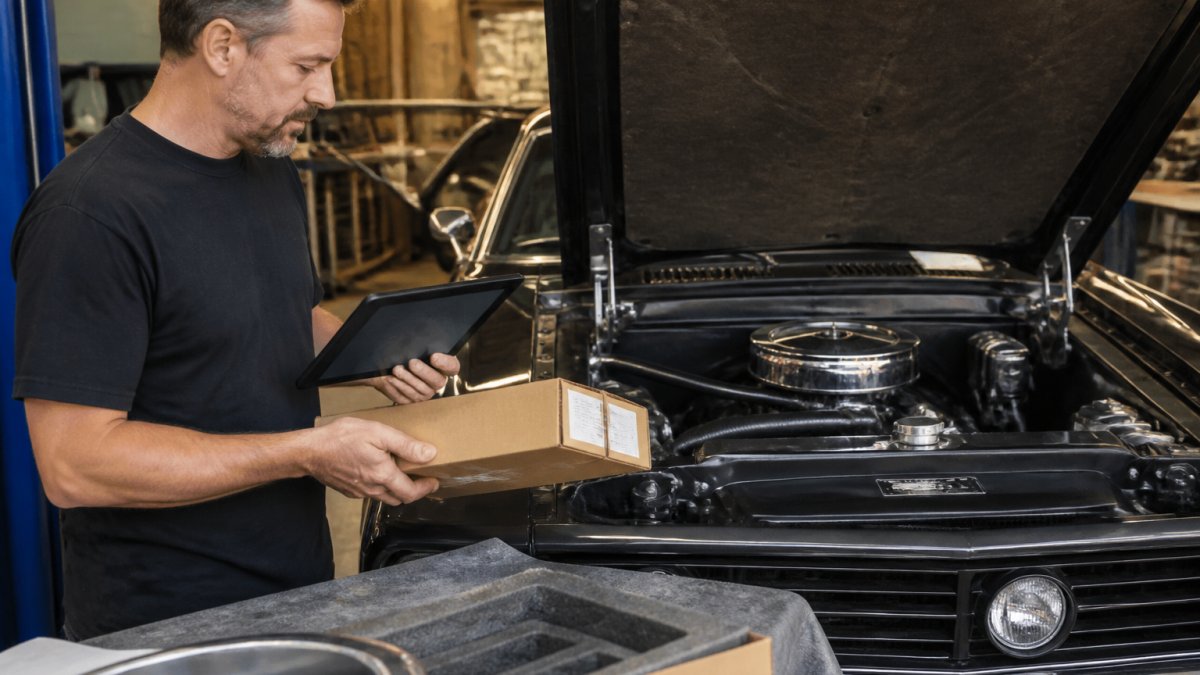
- Full VIN recorded and double-checked for lookalike characters
- Year, make, model, and trim confirmed against the VIN decode
- Engine, body style, and drivetrain verified
- Production date checked for mid-year splits
That last box matters as much as the rest. Ask before you order, not after.
Browse American Car Craft Accessories for Your Build
Every step above exists for one reason: a part that fits exactly looks better and installs without modification. That is the standard at American Car Craft.
Our accessories are handcrafted from stainless steel and carbon fiber, and our products include items officially licensed by General Motors, Ford, and Mopar.
Start with your vehicle:
Verifying precision fitment for car parts comes down to confirming the exact vehicle before you spend a dollar.
Frequently Asked Questions
How do I check whether a car part will fit my vehicle?
Start with the exact year, make, model, and trim, then confirm the part number against the seller's fitment listing. Pull your VIN and decode it to catch engine, drivetrain, and production-date differences that change which part fits. Cross-reference the OEM number and check dimensions for anything that mounts to the body or wheels. When the listing is unclear, call a parts specialist or the manufacturer before ordering, and confirm the return policy covers fitment issues.
Can I use my VIN to verify car part fitment?
Yes. The 17-character VIN encodes the model year, plant, engine, and restraint details, and a VIN fitment lookup narrows results to your exact build. Enter the VIN into a dealer parts catalog or manufacturer lookup tool and compare the returned part numbers to the listing. The VIN will not catch every difference, such as a mid-year production change or a modified vehicle, so treat it as the first filter and confirm dimensions and mounting points before you order.
Why might a part listed for my vehicle still not fit?
Catalog listings often group multiple trims, engines, or production runs under one fitment note, which hides real differences in mounting points, connector types, and clearances. A mid-year production change, an aftermarket modification, or a wheel offset that differs from stock can also cause a listed part to miss. Measure the mounting area and compare the part's dimensions to the removed original part. If the listing does not name your exact trim and production date, ask the seller to confirm before purchase.
What should I do if a part's fitment information is unclear?
Do not order on a guess. Ask the seller for the part number, the vehicles it was verified against, and the dimensions. Compare that to your VIN decode and the original part you removed. If the seller cannot confirm your exact year, make, model, and trim, request a written fitment confirmation or walk away. A clear return policy that covers fitment problems protects you, but the better move is confirming compatibility before the part ships.