 Comparison
Are Durable Carbon Fiber Parts for Exotics Worth It?
Last Updated: October 26, 2026
Quick Summary
Durable carbon fiber parts for exotics are worth it when the part uses UV-resistant resin, autoclave curing, and a UV-stable clear coat. Those three construction details decide whether a panel survives years of sun, heat, and road grit instead of yellowing, cracking, or delaminating.
- Real carbon fiber shifts and shimmers under direct light, while printed carbon-look trim stays flat and uniform.
- Confirm the seller lists your exact year, make, model, and trim rather than a year range.
- Mirror caps and small overlays are DIY-friendly and typically take under an hour to install.
- Wash with pH-neutral soap and a microfiber mitt, and skip automatic brush washes entirely.
- Delamination or cracked laminate is generally not repairable in a way that restores structural integrity.
Table of Contents
- What Makes Carbon Fiber Parts Durable Enough for Exotics?
- Real Carbon Fiber vs Carbon-Fiber-Look Trim: What Are You Actually Buying?
- A Carbon Fiber Car Parts Buyer's Guide for Exotic Owners
- Carbon Fiber Parts Fitment and Installation: Getting It Right the First Time
- Carbon Fiber Parts Care and Maintenance: Keeping the Finish Show-Ready
- What Long-Term Ownership Really Costs: Installation, Warranty, and Repair
- Browse Carbon Fiber Upgrades Built for Your Car
- Frequently Asked Questions
What Makes Carbon Fiber Parts Durable Enough for Exotics?
Durability in carbon fiber parts comes down to three things: the resin system, the cure process, and the protective finish. Get all three right and a panel survives years of sun, heat, and road grit. Get any one wrong and you get yellowing, cracking, or delamination.
The market is growing for a reason. Business Research Insights' 2026 carbon-fiber-in-automotive market estimate puts the global market at USD 1.02 billion in 2026, with projections toward USD 1.6 billion. More buyers means more sellers, and not all of them build to the same standard.
At American Car Craft, we have spent over 30 years handcrafting stainless steel and carbon fiber accessories. Here is how to tell premium parts apart before you spend a dollar.
The construction details that decide longevity
Carbon-fiber-reinforced polymer, or CFRP, is a composite of carbon fibers set in a resin matrix. The fibers carry load. The resin holds them in place and shields them from moisture and UV.
Three details separate a part that lasts from one that fades:
- Resin type. UV-resistant resin helps prevent yellowing, cracking, and delamination, according to Exotic Carbon Fiber's product guidance. Standard resin offers no such protection.
- Cure method. Autoclave curing produces fewer voids in the laminate. Voids are where cracks start.
- Topcoat. A UV-stable clear coat seals the surface. Scopione describes its parts as autoclave-cured and sealed under exactly that kind of coat.
Miss any of these and the part still looks good on day one. It is year three that tells the truth.
Real Carbon Fiber vs Carbon-Fiber-Look Trim: What Are You Actually Buying?
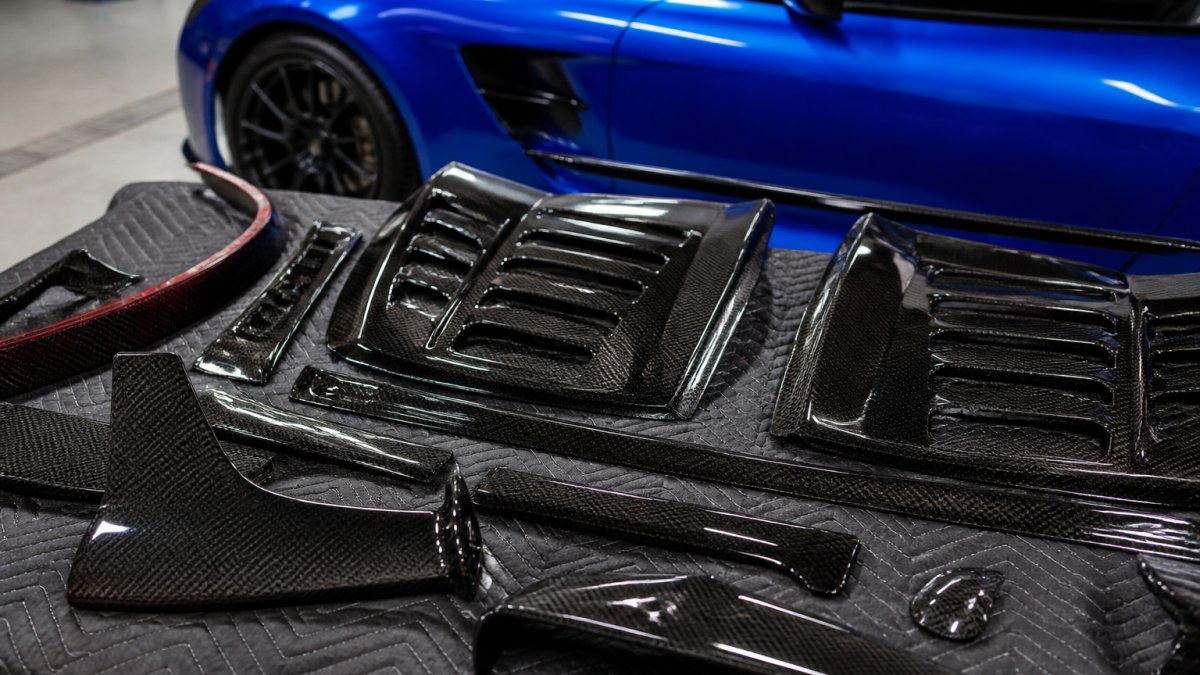
Real carbon fiber is a woven composite with visible fiber depth under a clear coat.
Here is the test we suggest: tilt the part under direct light. Real carbon fiber shifts and shimmers as the weave catches light at different angles.
Then check the weight. A genuine CFRP hood or splitter is noticeably lighter than the same part in ABS plastic.
The price gap exists because the materials and labor gap is real.
A Carbon Fiber Car Parts Buyer's Guide for Exotic Owners
Before you buy, verify four things: material, construction, finish, and fitment. Skip any one and you are gambling on the other three.
Our buyer's guide comes down to a short checklist:
- Seller states the material as CFRP, not "carbon fiber style"
- Resin is described as UV-resistant
- Clear coat is described as UV-stable
That list filters out most of the problem sellers in about ten minutes.
The comparison table: what separates a premium part from a cheap one
| Attribute | Premium Part | Budget Part |
|---|---|---|
| Material | CFRP with stated weave | Unstated or "carbon look" |
| Cure | Autoclave-cured | Open-mold, uncontrolled |
| Resin | UV-resistant | Standard polyester |
| Finish | UV-stable clear coat | None or thin spray |
| Fitment | Model-specific | "Universal" |
| Hardware | Included, documented | Often missing |
The pattern is consistent: cheap parts cut corners on the invisible steps. Those are the steps that decide whether the part survives a decade of sun.
Carbon Fiber Parts Fitment and Installation: Getting It Right the First Time
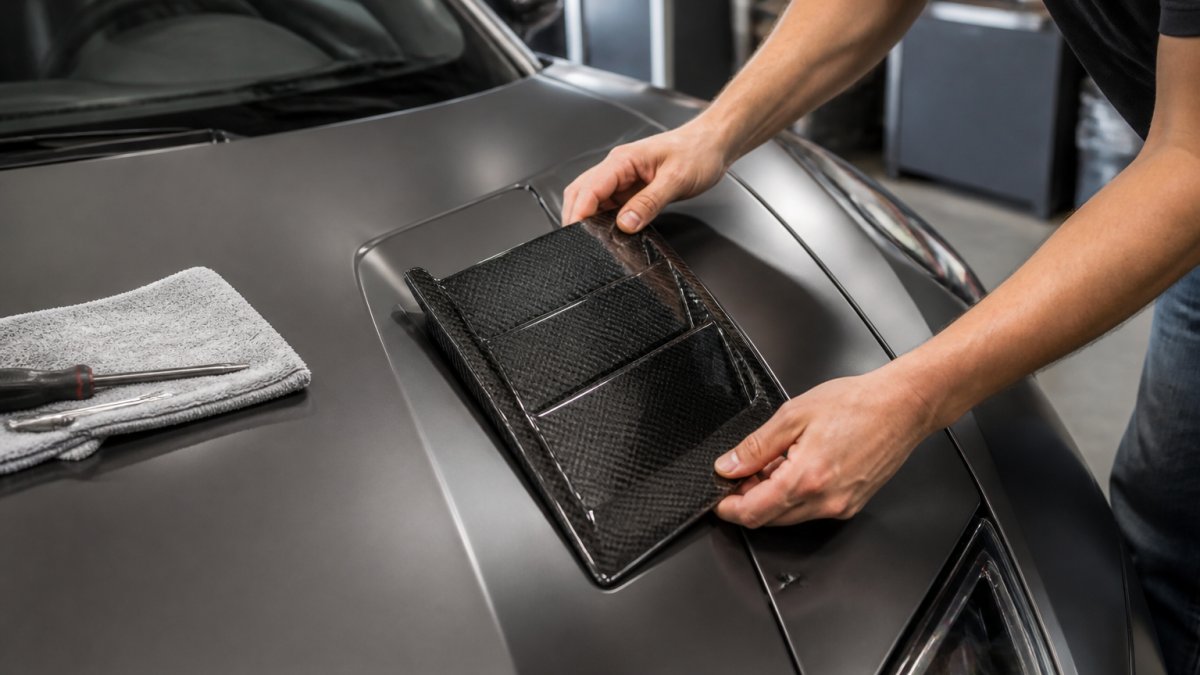
Fitment is where most aftermarket purchases go wrong. A part listed as fitting "most modern sports cars" fits almost none of them precisely. Exotic panels have tight tolerances, and a few millimeters of gap reads as a mistake at any car show.
Why exotic fitment is harder than it looks
Exotic platforms change more between model years than most buyers expect. A hood that fits a 2018 model may not clear the revised latch, hinge geometry, or underhood packaging on a 2021. The same pattern shows up across the category:
- Model-year running changes. Facelifts often move headlight buckets, bumper mounts, and hood shut lines by a few millimeters, enough to turn a "fits" part into a return.
- Trim and package differences. Performance trims frequently add larger radiators, extra coolers, or different front fascias that change the space behind a splitter or grille insert.
- Sensor and camera cutouts. Park-distance sensors, front cameras, and radar units sit in bumpers and grilles. A part without the correct cutouts either blocks the sensor or leaves an unfinished hole.
A fitment checklist that prevents costly returns
Before you order, confirm each of these in writing from the seller:
- Exact year, make, model, and trim are listed, not a year range
- Sensor, camera, and radar cutouts are specified if your car has them
- Mounting method is documented (factory hardware, tape, or drilling)
Installation difficulty by part type
Difficulty tracks the size of the part and how much factory hardware it touches:
- Mirror caps, interior trim, and small overlays. Genuinely DIY-friendly. Most attach with factory clips or automotive tape and take under an hour.
- Splitters, diffusers, and side skirts. Moderate. They often reuse factory mounting points but need two people for alignment and careful torque on fasteners.
- Hoods and large panels. The hardest category. Hinges, latches, struts, and washer nozzles all have to line up, and a second set of hands is mandatory.
Watch out: skipping the dry-fit step is the single most common cause of a misaligned panel that has to be pulled back off. Test-fit before you remove any adhesive backing, check the gaps, then commit.
Carbon Fiber Parts Care and Maintenance: Keeping the Finish Show-Ready
Care is simple, but it is not optional. The clear coat is what protects the resin underneath, and once it degrades, the composite follows. The difference between a part that looks new at year five and one that looks tired at year two is almost entirely maintenance.
What actually ages a carbon fiber part
Four forces drive most long-term deterioration:
- UV exposure. Sunlight breaks down the resin and clear coat, which is why yellowing usually starts on horizontal surfaces like hoods and roof panels before it shows on vertical ones.
- Heat cycling. Engine bays and dark panels in summer sun cycle through high temperatures repeatedly, stressing the resin-to-fiber bond.
- Moisture intrusion. Chips and cracks at edges and mounting points let water into the laminate, and freeze-thaw cycles widen the damage.
A maintenance routine that matches the exposure
- Washing. pH-neutral soap, a microfiber mitt, and two buckets. Skip automatic brush washes entirely, the brushes scuff clear coat.
- Protection. Apply a UV-protective sealant or wax every few months on exterior parts. On a daily-driven car in a sunny climate, err toward the shorter interval.
- Inspection. Check edges, mounting points, and leading surfaces each season. Chips at the edges are where moisture gets in, and moisture is what drives delamination.
Repairability: what can be fixed and what cannot
Repair outcomes depend on which layer failed:
- Clear-coat scuffs and light scratches. Usually repairable by a detailer with a light polish or a spot clear-coat blend.
- Chips at edges. Touch up early with a compatible clear coat. Small chips stay small if sealed; they spread if ignored.
- Delamination or cracked laminate. Generally not repairable in a way that restores structural integrity. The part should be replaced.
What to expect over time
A well-finished, UV-stable part on a garaged car holds its appearance for many years, while a budget part with a thin or absent clear coat can start to yellow within a couple of seasons of sun exposure. The pattern is consistent enough that finish quality is the best predictor of long-term appearance, which is why the construction details in the first section matter as much as the care routine.
What Long-Term Ownership Really Costs: Installation, Warranty, and Repair
The purchase price is only the first number. Budget for installation, protection, and possible repair.
Installation runs from free, if you do it yourself on trim pieces, to professional labor on hoods and aero. Add a UV sealant twice a year.
Warranty terms vary widely by seller, and the research we reviewed does not show consistent warranty standards across the category.
Browse Carbon Fiber Upgrades Built for Your Car
We build carbon fiber and stainless steel accessories for modern muscle cars, classic hot rods, and exotics, handcrafted in our shop and backed by over 30 years of experience.
The difference between a part that lasts and one that fades shows up in year three, not week one. Buy for the long term.
Get started with American Car Craft and give your car the show-ready finish it deserves.
Frequently Asked Questions
Are carbon fiber parts durable enough for daily driving?
Quality carbon fiber parts hold up well in daily use, but durability depends on construction and finish. UV-resistant resin and a UV-stable clear coat are the two features sellers cite most for preventing yellowing, cracking, and delamination over time. Parts with poor resin or no topcoat degrade faster under sun and temperature swings. If your car sits outside, prioritize parts described as autoclave-cured or sealed under a protective clear coat, and expect to maintain that finish with regular cleaning and wax.
How can you tell if a carbon fiber car part is high quality?
Look at the weave first. A quality part has a straight, even twill or plain weave with no gaps, waviness, or cloudy patches under the clear coat. Check the edges for clean trimming rather than rough, splintered cuts. Ask whether the part is autoclave-cured and sealed with a UV-stable topcoat, since those steps affect both strength and how long the finish lasts. For fitment, confirm the part is listed for your exact year, make, and model rather than a generic fit.
What is the difference between real carbon fiber and carbon-fiber-look trim?
Real carbon fiber is a carbon-fiber-reinforced polymer: actual woven carbon cloth set in resin, which gives it high strength-to-weight ratio and a depth you can see and feel under the clear coat. Carbon-fiber-look trim is a cosmetic finish, typically a printed film or hydro-dipped pattern over plastic or metal. It can look convincing in photos but adds no structural benefit and often shows a repeating pattern that looks flat up close. For show cars, real carbon fiber parts carry the credibility judges and buyers recognize.
Do carbon fiber parts need special care?
They need less care than paint but more than bare plastic. Wash with a pH-neutral car soap and a soft mitt, then dry with a microfiber towel to avoid scratching the clear coat. Apply a quality wax or ceramic coating every few months to reinforce UV protection. Avoid harsh degreasers, abrasive polishes, and automated brushes. If you park outside, a cover slows sun damage. Inspect edges and mounting points annually for chips or lifting clear coat, and address small issues before they spread.
Can carbon fiber parts be repaired if they are damaged?
Cosmetic damage like clear-coat scratches or small chips can usually be sanded and re-cleared by a body shop experienced with composites. Structural damage, such as cracks in the laminate, requires proper composite repair and should not be patched with filler. Repair cost varies widely by part and damage type, so ask about warranty terms before buying and keep installation receipts. For low-cost cosmetic trim, replacement is often more economical than repair.
Durability in this category is a construction question, not a marketing claim. Ask sellers what resin they use, how the part is cured, and what coat protects it. American Car Craft answers all three, with over 30 years of handcrafted work behind every piece, officially licensed parts from General Motors, Ford, and Mopar, and precision laser-cut fitment built for your exact vehicle. Browse the catalog and upgrade with parts made to last.